The Cushion Plants That Keep Close to the Ground
Cushion plants make exposed uplands easier to read: learn how to spot their form, notice their setting, and distinguish a true cushion from a look-alike.
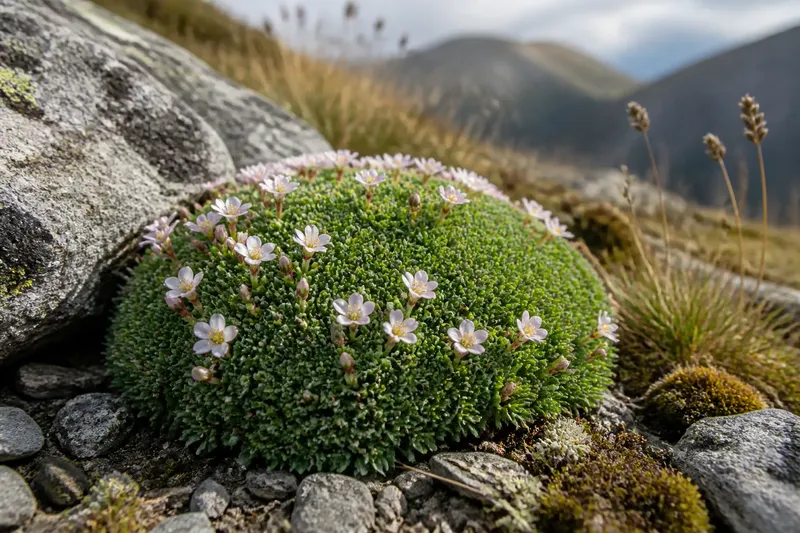
The common mistake with cushion plants is to treat a low, rounded patch as a miniature shrub and move on. That quick glance costs you the best part: a chance to see how the plant’s shape responds to wind, cold, thin soil, and the small pockets of shelter around it. Cushion plants are easier to understand when you read the ground around them as carefully as the greenery.
On an upland walk, take a moment to look before you touch or step closer. A cushion may be a single plant or a dense cluster of shoots, and its rounded outline can be subtle among stones, grasses, and moss. The aim is not to identify every species at a glance. It is to notice the form, the conditions, and the plant’s place in the landscape.
Start with the outline
Look for a compact mound or mat that stays close to the surface. Some cushions are smoothly domed; others form uneven pads broken by tiny leaves, short stems, or exposed rock. Their growth can be so tight that the plant looks like a patch of green velvet from a distance, then resolves into many small parts when you crouch nearby.
Compare the patch with the plants around it. A cushion often has a clearer edge than a loose clump of grass, and its shoots tend to crowd together rather than rise on long, separate stems. A mossy hummock can also look rounded, so look for the structure of leaves and shoots rather than relying on silhouette alone.
Keep your feet on the path or on durable bare ground while observing. In fragile upland vegetation, a boot can flatten a slow-growing patch or loosen the shallow soil that holds it in place. Binoculars or a phone camera with a close-focus setting can help you inspect details without trampling the surrounding plants.
Read the growing conditions
Once you have found a likely cushion, scan a short distance around it. Notice whether the ground is rocky, gravelly, or peat-rich; whether water drains away or collects; and whether the plant sits in an exposed patch or beside a stone that breaks the wind. These clues help explain why a low form may suit that exact spot.
Wind can strip warmth and moisture from upright growth. A compact form presents less exposed surface to the air, while the crowded shoots can create a sheltered space within the mound. The shape may also help the plant remain close to the warmer boundary layer at the ground. These are useful general explanations, not a claim that every cushion species responds in precisely the same way.
Cold and a short growing season matter too. Near the ground, a plant can benefit from shelter provided by terrain, litter, or neighboring vegetation. But a low position is not automatically comfortable: waterlogged hollows, shifting scree, and frost exposure can all make life difficult. Look for the combination of conditions, not a single cause.
Soil depth is another clue. Many upland sites offer only a thin layer of soil over rock, and a plant with a compact habit can occupy a small pocket rather than relying on a tall, extensive structure. If a cushion is tucked into a crack or against a boulder, note the association without assuming the stone alone explains its presence.
Notice how the shape works
Observe the cushion from the side, then from above. A low profile may help reduce exposure to wind, while dense growth can buffer the plant’s inner shoots from sudden changes in temperature and drying air. In some species, the shape also gathers leaves and stems into a tight surface that can catch fine organic material or retain moisture locally.
Do not assume every rounded plant is built for the same reason. Species differ in leaf texture, root systems, flowering habits, and tolerance of wet or dry ground. A cushion-shaped form is a visible clue, not a complete explanation of the plant’s biology.
Look for variation within the patch. The center may be denser than the edge; one side may be clipped by wind or exposed to sun; flowers may rise just above the foliage. Such differences show that a cushion is not a perfect, uniform ball. It is a living growth pattern shaped by its surroundings.
Compare nearby plants
Turn your attention to the plants beside the cushion. Are they taller and more flexible, or do they also hug the ground? A patch of cushion plants surrounded by short grasses can make the contrast especially clear. Nearby lichens and mosses may share the same rocky surface, but they are not flowering plants and should not be mistaken for a cushion species.
Notice whether the cushion occurs alone or in repeated patches. Several similar forms across a slope may suggest that the site offers a recurring set of conditions, such as exposed rock pockets or a particular kind of drainage. A single mound could instead reflect a small local shelter or a gap in the surrounding vegetation. The pattern is worth noting, but it does not identify the plant by itself.
Flowers can offer stronger clues than foliage. If the plant is flowering, record the flower color, shape, and position: does it emerge from the cushion’s surface, or does a stem lift it above the leaves? Take a photograph that includes both a close view and the surrounding ground. Avoid picking flowers or pulling leaves for identification.
Make a field note
A useful field note records what you can see, not what you guess. Write down the slope’s exposure, the surface material, nearby shelter, and whether the ground appears dry, damp, or wet. Add the plant’s outline, leaf arrangement, and any flowers or seed heads. A simple sketch can capture the cushion’s relationship to a stone or patch of grass better than a name you are unsure about.
Say you spot a tight green mound beside a flat rock on a windy, gravelly slope. You note its low dome, the short leaves at the edge, and the small flowers just above the surface, then photograph the patch from the path. Later, a local plant guide may help narrow the identification; even if the name remains uncertain, your notes still describe how the plant occupies that setting.
When using a field guide or identification app, compare several features rather than matching one photograph. Leaf shape, flower structure, habitat, and local range can all matter. If two possibilities remain, record the plant as an uncertain identification rather than forcing a name. That restraint keeps the landscape observation useful.
What is worth noticing?
Are all low mounds cushion plants?
No. Mosses, compact grasses, and other small plants can form rounded patches. Check for the plant’s leaves, stems, and flowers, and use a field guide if you want a species-level identification.
Why do cushion plants grow so tightly?
A dense, low form can reduce exposure and create a more sheltered space among the shoots. The advantages vary by species and site, so treat the shape as a clue to investigate rather than a single universal adaptation.
Can I touch a cushion to inspect it?
It is better to observe without handling it. Upland plants may grow slowly, and pressure can damage shoots or disturb shallow soil; use a close photograph or binoculars instead.
Where should I look for them?
Check rocky slopes, exposed ridges, gravelly ground, and other upland habitats, while staying on durable ground. The particular plants present depend on local conditions, so a regional field guide is more useful than a single broad expectation.
Leave the patch intact
Cushion plants can be easy to overlook precisely because they do not rise above the surrounding ground. Once you recognize their compact outline, the upland surface starts to look more varied: tiny sheltered pockets, exposed edges, and patches where plants take different forms side by side. That close reading is part of the reward of a slow walk.
Keep the observation light on the land. Stay on established paths where possible, avoid stepping onto cushions, and do not remove plant material. If you want to remember a particular patch, note its setting and take a photograph from a stable spot. The most useful detail may be the relationship between the cushion and the ground around it, not its name.